
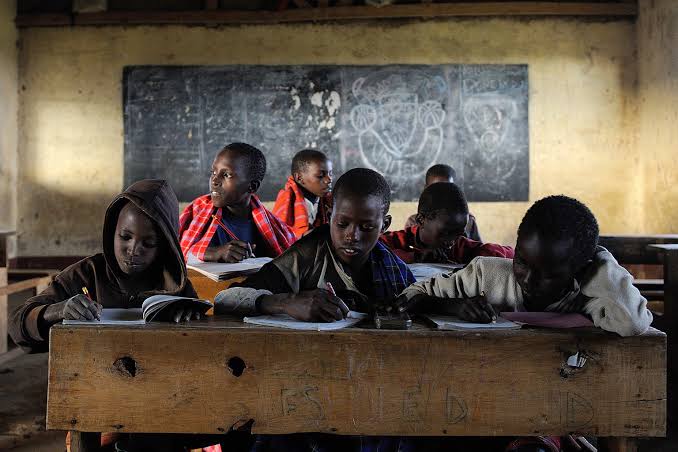
Poverty is rarely one problem. It is a set of interlocking shortages that reinforce one another. A family without income struggles to keep children in school. Children who leave school early earn less as adults. Their own children then start from the same place. Economists call this a poverty trap, and it is one of the most persistent patterns in global development.
Education is the most reliable tool we have for breaking it. The evidence for this is consistent across countries, income levels, and decades of research. But education requires more than textbooks. Classrooms need light. Students need somewhere to study after dark. Schools need power to run computers, pumps, and refrigeration. That is where energy access enters the story, and it is why the relationship between education and poverty matters so much to the work we do at SELF.
What the evidence says about education and poverty
The link between schooling and poverty reduction holds up under rigorous measurement.
A panel study of 34 European countries examined how educational and cultural indicators affect the share of people at risk of poverty or social exclusion from 2015 to 2019. The study found that higher levels of education and cultural participation were associated with lower poverty. Even more interesting, the results were stronger when researchers introduced a one year lag. Investment in education does not pay off instantly. It pays off later, and it keeps paying.
Global figures tell the same story at scale. UNESCO estimates that if all students in low-income countries left school with basic reading skills, roughly 171 million people could escape extreme poverty. If every adult completed secondary school, the global poverty rate would fall by more than half, lifting an estimated 420 million people out of poverty. In Tanzania, completing secondary education cuts the likelihood of being poor as a working adult by nearly 60 percent. Each additional year of schooling raises earnings by around 10 percent on average, and the return is often higher for women.
Education also drives growth at the national level. A study co-published by Stanford University and Ludwig Maximilian University found that between 1960 and 2000, roughly 75 percent of global GDP growth was linked to improvements in math and science skills. The knowledge capital of a nation and its long-run growth rate track each other closely.
Poverty also blocks education, which is what makes the cycle so hard to break
The relationship runs both ways. Economic hardship damages a child’s ability to learn long before it shows up on a test score.
In the United States, roughly 10 million children were living in poverty as of 2023, about one in seven public school students. Those students are more likely to attend schools with larger class sizes, fewer advanced courses, less experienced teachers, and higher staff turnover. They are less likely to have a computer or reliable internet at home. Housing instability moves them between schools midyear, breaking continuity in both instruction and relationships.
The effects reach into cognition itself. A 2019 study by researchers at the University of East Anglia found measurable differences in brain structure and function among children growing up in poverty, particularly in regions tied to language and memory. Chronic stress impairs working memory, self regulation, and cognitive flexibility. Food insecurity affects concentration and behavior in the classroom. None of this reflects ability. It reflects conditions.
Those gaps compound. They appear early, widen over time, and show up later as lower graduation rates, lower college completion, and fewer professional networks to draw on. This is what makes poverty and education a cycle rather than a single barrier.
Energy poverty is the barrier behind the barrier
For roughly one billion people, there is a further obstacle: schools and homes without reliable electricity.
When a classroom has no power, the school day ends at sunset. Study after dinner becomes impossible without kerosene, which is expensive, dangerous, and bad for respiratory health. Without electricity, computer labs or scientific equipment are a distant dream. Teachers are harder to recruit and retain. Students are cut off from the digital resources their peers elsewhere take for granted.
This is the practical reality documented in our work on the social costs of energy poverty in Uganda, where millions still live without safe, affordable electricity, and where the shortfall limits health, education, and income. Energy poverty and educational poverty are not parallel problems. They are the same problem viewed from different angles.
The reverse is equally true. Bring power to a school, and the constraints lift quickly. Our work on the solar electrification of schools shows what changes when classrooms stay lit: longer study hours, functioning technology, and a school that can serve as a community hub outside class time. In South Africa, powering rural schools in the Eastern Cape brought computers and ICT training to a cluster of marginalized communities near Mthatha. In Haiti, restoring a school’s solar battery bank brought the lights back for five hundred residential students whose safety depended on it.
Seven ways education reduces poverty
The economic argument is the most cited, but it is far from the only one. Education changes outcomes across nearly every dimension of wellbeing.
Higher lifetime earnings. Educational attainment correlates strongly with income and employment stability, and the effect carries across generations.
Lower inequality. A 2019 Oxfam report described good quality education as a leveler and equalizer within society. Where it is tailored to marginalized communities, it works directly against the systemic barriers that keep specific groups furthest behind. Solar energy can reduce inequality across several dimensions.
Better maternal and child health. Research from the World Bank and the International Center for Research on Women across 15 sub-Saharan African countries found that educated women tend to have fewer children and have them later, leading to safer pregnancies and healthier newborns.
Lower stunting rates. In Bangladesh, higher maternal education reduced the odds of stunting by 4.6 percent, with paternal education contributing a further 2.9 to 5.4 percent. In Nairobi, children born to mothers with some secondary education were 29 percent less likely to be stunted. Nutrition and learning reinforce each other, which is why food security belongs in any serious poverty strategy.
Reduced disease vulnerability. Keeping girls in school is associated with lower risk of HIV infection, and school-based programs also reduce stigma against people living with HIV and AIDS.
Climate resilience. A 2014 analysis in Ecology and Society found that more educated individuals are better informed about disaster risk and more likely to prepare for it. They also tend to have wider social networks and more financial cushion to absorb losses.
Less violence at home and in the community. Each additional year of secondary schooling reduces the likelihood of child marriage. Women who marry later and have fewer children are less likely to experience intimate partner violence. Physical safety matters here too, which is why solar lighting in public spaces has such a direct effect on whether girls can travel to and from school at all.
What effective intervention looks like
The research points toward a few consistent conclusions for anyone designing programs or policy.
Start early. High quality early childhood education builds the foundational skills that close achievement gaps before they widen.
Fund equitably. School systems financed mainly through local property taxes reproduce the inequality they are meant to address. Targeted funding formulas that direct more resources to high-need schools do the opposite.
Address the whole child. Community school models that co-locate health services, meals, family support, and after-school programming treat the multiple deprivations that arrive together. Free breakfast and lunch programs remove hunger as a variable. Tutoring and small group instruction provide the individual attention that under-resourced classrooms cannot.
Build the infrastructure first where it is missing. In off-grid communities, none of the above is possible without power. That is why fighting energy poverty through solar solutions has to come alongside educational investment rather than after it. Solar also unlocks water security, clinic operations, and economic opportunity in the same communities, which is what makes it such an efficient entry point.
Give communities ownership. Systems that communities help design, operate, and maintain last far longer than systems handed over as finished products. This is the principle behind community-owned solar, and it applies equally to school infrastructure.
The long view
The European panel data carried one finding worth sitting with. The relationship between education and poverty reduction was weakest when measured in the same year, and strongest with a one year lag. Progress is real but not immediate. It requires patience from funders, governments, and communities alike.
That patience is warranted. Education raises earnings, improves health, delays marriage, reduces violence, strengthens climate resilience, and drives national economic growth. Few interventions do so much at once. But for roughly a billion people, the first obstacle is not curriculum or teacher training. It is that the lights do not come on.
At SELF, we treat energy as the enabling layer beneath all of it. Our work on solar energy for education exists because a school without electricity cannot deliver on any of the promises above, no matter how good its teachers are. Reliable power turns a building into a school, a school into a community resource, and a community resource into a route out of poverty.
That route works. The task is making sure it is open to everyone.
Help students learn with solar power
A gift to SELF brings solar power to schools beyond the grid, so students can study, use computers and keep learning after dark.
0 Comments